
If you thought history was all dusty tomes and dry lectures, think again! The Bayeux Tapestry—one of the most famous artefacts from the Middle Ages—has been hiding a saucy secret in plain sight for nearly a thousand years.
And now, historians are abuzz with the possibility that this X-rated detail could upend everything we thought we knew about the Norman Conquest and the very foundations of modern Europe.
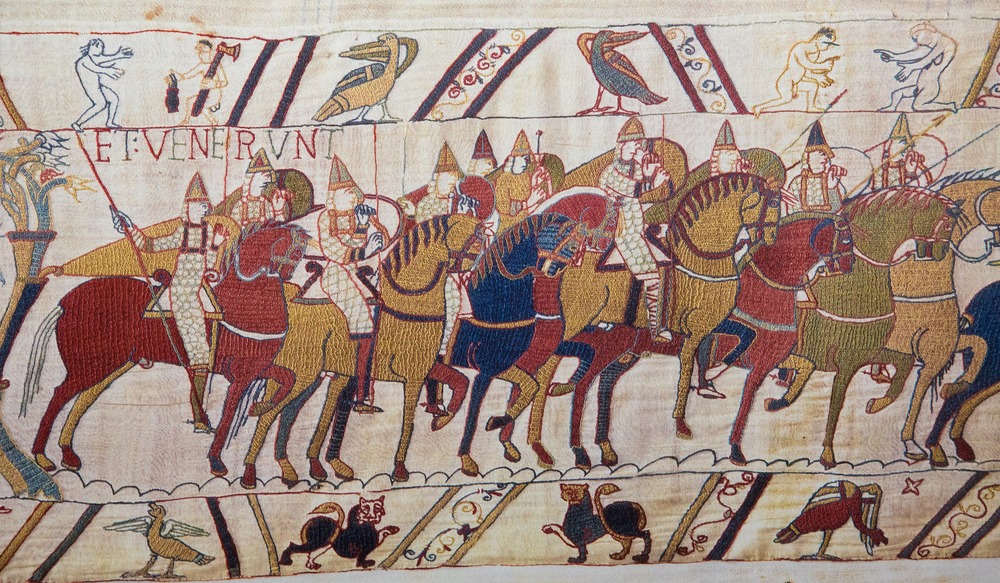
Let’s set the scene: The Bayeux Tapestry, a sprawling 70-metre-long embroidered masterpiece, chronicles the events leading up to the Battle of Hastings in 1066. This was the moment when William the Conqueror, Duke of Normandy, invaded England and forever changed the course of British history.
The tapestry is a visual feast, packed with knights, ships, and dramatic scenes—but look a little closer, and you’ll spot something decidedly cheekier.
Among the 58 scenes stitched into the tapestry, eagle-eyed experts have counted a staggering 93 (or 94, depending on who’s counting) phalluses. Yes, you read that right! Some are subtle, some are not-so-subtle, and their presence has sparked endless debate. Are they the medieval equivalent of schoolboy graffiti? Or could they be sly, subversive jabs at the powerful figures depicted in the work?
But as titillating as these details are, they’re not the real scandal. Hidden within the tapestry’s intricate threads is a scene that could have rocked the very legitimacy of William’s claim to the English throne.
A Royal Affair Or a Medieval Smear Campaign?
The most eyebrow-raising vignette shows a clergyman tenderly touching the cheek of a noblewoman named Aelfgyva, while a naked man lurks below in the decorative border.
According to Professor Michael Lewis, a curator at the British Museum, this isn’t just a random moment—it could be a coded reference to a royal sex scandal.
Here’s where things get juicy: Professor Lewis believes the woman depicted is none other than Emma of Normandy. Emma was a political powerhouse—wife to King Aethelred the Unready, mother to Edward the Confessor, and great-aunt to William the Conqueror himself.
When Edward died without an heir, William used his family connection to Emma as a key part of his claim to the English throne.

But what if Emma’s reputation wasn’t as spotless as history suggests? Rumours swirled that she had an affair with Alfwin, the Bishop of Winchester. If true, this would have cast doubt on the legitimacy of her children—and, by extension, William’s right to rule.
The tapestry’s suggestive scene may have been a not-so-subtle attempt to undermine William’s claim, hinting at scandal and illegitimacy at the very heart of the Norman dynasty.
A Mystery Wrapped in Embroidery
Of course, the true identity of the woman in the tapestry is still hotly debated. ‘Aelfgyva’ was a common name in 11th-century England, and some historians argue she could have been Aelfgyva of York (first wife of Aethelred) or Aelfgyva of Northampton (wife of King Cnut, whom Emma married after Aethelred’s death). The ambiguity only adds to the intrigue.
Let’s also not gloss over the tapestry’s infamous abundance of male anatomy. Some scholars suggest these were added by mischievous embroiderers, poking fun at the powerful or simply indulging in a bit of medieval humour.
Others think they might have had symbolic meaning—perhaps representing fertility, virility, or even the chaos of war. Whatever the reason, they certainly make the tapestry a conversation starter!
Why Does This Matter?
If Professor Lewis’s theory holds water, it means the tapestry wasn’t just a straightforward record of events—it was a piece of propaganda, designed to shape public opinion and cast doubt on the new regime.
It’s a reminder that history is often written (or stitched!) by the victors, and that even the most revered artefacts can have hidden agendas.
For those of us who love a good historical mystery, the Bayeux Tapestry is a treasure trove. It’s a vivid window into the past, full of drama, intrigue, and more than a little naughtiness.
Key Takeaways
- A risqué scene in the Bayeux Tapestry could hint at a royal sex scandal involving Emma of Normandy, possibly undermining William the Conqueror’s legitimacy as king.
- The tapestry, famous for its abundance of phallic imagery, depicts a clergyman caressing a woman (possibly Emma/Aelfgyva) as a naked man looks on, fuelling speculation of an affair.
- Historians believe rumours that Emma had an affair with Bishop Alfwin were woven into the tapestry as an attempt to question William’s rightful claim to the English throne.
- The true identity of the woman remains uncertain, with several historical figures named Aelfgyva suggested, leaving the tapestry’s meaning—and its impact on history—open to interpretation.
Have you ever seen the Bayeux Tapestry in person, or perhaps studied it in school? Do you think these hidden details were intentional, or just the work of bored medieval artists? And what do you make of the idea that a thousand-year-old scandal could have changed the course of European history?
We’d love to hear your thoughts! Share your opinions, theories, or even your favourite historical mysteries in the comments below. Let’s get the conversation started—after all, history is far more entertaining when we dig beneath the surface!