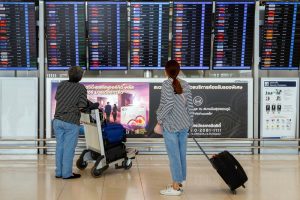
Travelling is meant to be a time of joy, adventure, and making memories with loved ones. But for one Melbourne family, a simple mix-up at an Indonesian airport turned their dream holiday into a financial nightmare, costing them a staggering $28,000.
If you’re planning a trip overseas—especially to popular destinations like Indonesia—this is a cautionary tale you can’t afford to miss.

A Holiday Gone Wrong: The Suitcase Switch That Started It All
Natasha and her family of five were on their way home from a memorable overseas adventure, with a brief stopover in Jakarta, Indonesia.
Like many of us, they were tired after a long journey and, in the hustle and bustle of the airport, accidentally picked up the wrong black Samsonite suitcase. It’s an easy mistake—how many of us have stood at the baggage carousel, squinting at a sea of nearly identical bags?
Upon arriving at their hotel, The Ritz Carlton, the family quickly realised the error. The suitcase was the wrong size, and thankfully, their own bag was trackable thanks to Apple AirTags. Natasha’s sons, aged 12 and 15, were especially anxious—their birthday presents were inside the missing luggage.
A High-Tech Scam Unfolds
The AirTag showed the missing suitcase was still at the airport. Natasha reached out to the hotel staff, who assured her they would help retrieve it. Soon after, she received a message via the hotel’s WhatsApp account with a payment link, supposedly to cover a ‘small fee’ for the suitcase’s return.
Trusting the process, Natasha attempted to pay using her Qantas Titanium credit card. When the link didn’t work, she tried multiple times and even switched to her Bendigo Bank account.
That’s when she received a fraud alert from her bank—and discovered, to her horror, that $28,000 had been drained from her credit card in just 30 minutes, across four rapid transactions.
‘I tried the card four times, and then I just thought, this is very strange,’ she recounted.
The scammers had struck: $6,330 in the first hit, $7,832 in the second, a whopping $12,333 in the third, and $2,146 in the fourth. To add insult to injury, international transaction fees added another $860 to the bill. Natasha recalled the experience as ‘very traumatic’.
‘I just felt sick to my stomach and thought I’d been scammed, and that has gone forever. I’ll never get that back’ she continued. And just like that, the family’s holiday joy was replaced by shock, anxiety, and a mountain of debt.
‘Then I went to the hotel (and said) “Why did you send me an unsecured payment link?” They just didn’t really say anything and didn’t know what to do.’
A Web of Frustration: Banks, Hotels, and No Easy Answers
Natasha immediately contacted Qantas Money, but was told the transactions couldn’t be stopped—they’d already been processed through a cash app called Tokopedia. Despite the transactions being ‘pending,’ the bank’s focus was on replacing her card, not recovering the funds. Natasha was left feeling unsupported and frustrated, especially given the $1,200 annual fee for her premium card.
‘I was very shocked and disappointed with the poor security. The annual card fee is $1200 – what am I paying for?’ She shared, adding that everytime she received an email from Qantas, whether it’s for frequent flyers or health insurance, she feels ‘anxious and sick’ to her stomach.
To make matters worse, Natasha’s credit card provider, Qantas Money (with NAB as the underwriter), refused to accept liability. Despite the transactions being flagged as suspicious and still pending when Natasha called, she was told nothing could be done. The bank cited that a one-time password (OTP) had been used to authorise the payments, so the responsibility lay with her.
‘At the time of the transaction you have disputed, the code was provided to satisfy this additional layer of security. As such, we do not accept liability, and we’re unable to progress your claim,’ it said.
A spokesman for Qantas shared that modern scams are increasingly becoming sophisticated, with deceptive tactics targeting innocent customers during their most vulnerable moments.
‘As the card issuer and underwriter for Qantas Money, NAB is responsible for all banking and security matters, including transaction monitoring, fraud protection, and account servicing. Qantas Frequent Flyer is responsible for the distribution of Titanium credit cards to customers and the delivery of loyalty features like lounge access and point offers,’ they said.
Now, Natasha and her husband are locked in a dispute with NAB (the card issuer) and have lodged a complaint with the Australian Financial Complaints Authority (AFCA). While they wait for mediation, they’re being charged nearly $570 in interest and $30 in late fees each month—on top of the original loss.
Natasha shared: ‘The card has a limit of $40,000. I’d spent $10,000 on it on my trip in Europe, so they drained it.’
‘I’m challenging the bank, and I’ve also made a complaint with the Australian Financial Complaints Authority (AFCA) to get some answers as to why such a large amount of money was available to be scammed off the card in such a quick succession of time,’ she continued.
‘My husband and I are trying to save a deposit to buy a family home, and it will have to wait until this debt has been sorted.’
The Scam’s Wider Web: Trusted Brands and International Confusion
Meanwhile, NAB executive of Investigations Chris Sheehan said: ‘One‑time passwords are a key security measure used to confirm that a payment is being authorised by the customer, and we strongly advise customers not to share them.’
He continued: ‘Once a customer authorises a payment – particularly when it’s sent overseas – recovery becomes extremely difficult. In these circumstances, funds are often moved quickly beyond reach, leaving limited or no opportunity for recovery.’
But the family’s ordeal didn’t end with the financial loss. They had to pay another $1,500 to finally get their suitcase returned to Melbourne—only to find it tagged with Garuda Airlines, even though they’d flown with Etihad. Natasha suspects the scam is orchestrated by airport ‘scouts’ who target lost luggage and funnel it into a network of fraudulent contacts.
‘It had a Garuda Airline baggage tag on it. I didn’t fly with Garuda, I flew with Etihad. Obviously, this scam begins in the airport. Scouts are looking for lost luggage that gets sent to the location with the fraudulent phone number. I was scammed by three of the big trusted brands — Google, The Ritz Carlton and Qantas Titanium,’ Natasha recalled.
A Google spokesman shared that the company does not tolerate this kind of activity. ‘We are looking into the specific matter you have raised with us and will take appropriate action in line with our policies,’ they stated.
Natasha’s husband has also tried to negotiate with The Ritz Carlton, stating that the hotel had even involved its IT department due to this ordeal. ‘Again, the secure link provided by your hotel failed to process the payment,’ he wrote. ‘At this point, (the hotel) told my wife to immediately delete the secure payment link at the urgent advice of your hotel’s IT department.’
He added that the hotel chain has a policy to create a ‘secure payment link’ and then send it to the guest.
‘The result is that, due to your staff not following company processes, my family has had [an incredible sum of money stolen], and … experienced a high level of emotional and obviously financial distress,’ he shared with the hotel’s team.
He also proposed compensation of four million Marriott points and being upgraded to premium elite status for three years, but this was rejected by the hotel group.
A spokesman from the Ritz Carlton Jakarta said that ‘this matter is currently under investigation with relevant authorities, and we remain committed to supporting our guest and cooperating with the investigation.’
The Aftermath: Financial and Emotional Toll
For Natasha and her family, the financial loss was devastating—but so was the emotional impact. The experience left them anxious, distrustful, and hesitant to travel again. Natasha bravely shared her story, despite feeling ashamed, in the hope that it would prevent others from falling into the same trap.
‘It’s hard to talk about … I haven’t really told many people because I’m so ashamed about what happened. But I would really like it to be out there so it doesn’t happen to another family or person. A lot of Australians go to Bali and Indonesia all the time,’ she shared.
‘I don’t want to go back to that part of the world or even just being in a fancy hotel. It gives me a little bit of anxiety.’
Key Takeaways
- A Melbourne family lost $28,000 to scammers after accidentally taking the wrong suitcase at Jakarta airport, highlighting the risks of luggage mix-ups and travel scams in Indonesia.
- The family were duped into entering their credit card details into an unsecured payment link provided via their hotel’s WhatsApp, after being told it was required to recover their missing suitcase.
- Their Qantas Titanium credit card was drained in four transactions within 30 minutes, with both Qantas Money and NAB refusing liability due to the use of one-time passwords, leaving the family battling large debts and accruing interest.
- The ordeal has left the family emotionally distressed and out of pocket, prompting them to warn other travellers to be vigilant about scams involving lost luggage, unsecured payment links, and impersonation of trusted brands.
Have you or someone you know ever been caught up in a travel scam? What steps do you take to protect yourself when travelling? Share your stories, tips, and questions in the comments below—your experience could help another member avoid a similar fate.